How much house can you ACTUALLY afford in Ontario? It's not what you think — and the difference matters more than you know.
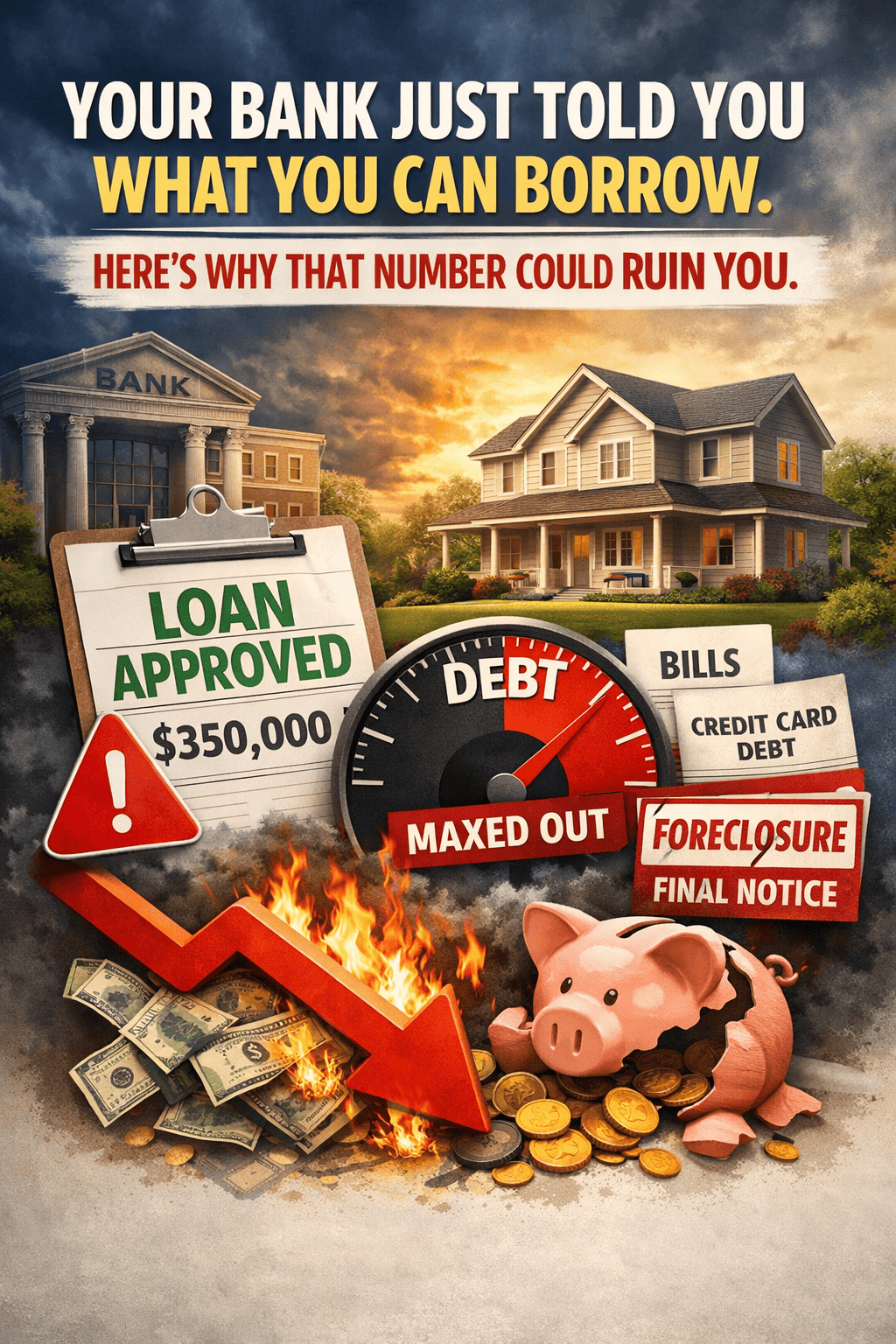
Picture this: You've been pre-approved for a $750,000 mortgage. You're thrilled. You start browsing listings. You find the house. You make the offer.
Then the monthly statement arrives after closing — and you realize the mortgage payment, property taxes, utilities, and maintenance are consuming 52% of your take-home pay. Date nights are gone. Vacations are a memory. One car repair away from missing a payment.
Welcome to being 'house poor' — one of the most common and most preventable financial traps for Ontario homebuyers.
The bank told you what you can borrow. Nobody told you what you can actually afford. Those are two very different numbers — and this article will show you exactly how to find yours before you commit to the biggest purchase of your life.
Why Your Bank's Number Is Dangerously Misleading
Banks are in the business of lending money. The larger the mortgage, the more interest they earn over 25 years. That doesn't make them villains — but it does mean their pre-approval represents the absolute maximum you can borrow, not a recommended budget.
Your lender calculated your maximum using gross income (before taxes), a stress-tested rate, and debt ratios. What they did NOT factor in:
• Your actual take-home pay after income tax
• Childcare costs, which can run $1,500–$2,500/month per child in Ontario
• Your RRSPs, TFSAs, or retirement savings contributions
• Your lifestyle — travel, dining, fitness, hobbies
• Home maintenance (typically 1–2% of home value annually)
• The full cost of utilities in a larger home
📊 The Reality Gap A family earning $140,000/year might qualify for a $850,000 mortgage. But after income tax (~$38,000), CPP/EI ($6,000), childcare ($24,000/year), and retirement savings ($10,000/year), their actual spending money is roughly $62,000/year — or $5,167/month. A $850K mortgage at today's rates costs around $4,400/month in mortgage payments alone. Before property tax. Before utilities. |
This gap between 'what the bank approves' and 'what you can comfortably sustain' is why so many Ontario households feel strangled by their mortgages within 18 months of buying. You can prevent this entirely with a more honest calculation upfront.
The Hidden Costs Most Ontario Buyers Forget to Budget
The purchase price is just the beginning. Here are the costs that routinely shock first-time buyers — and that need to be factored into your real affordability picture.
Closing Costs (Due on Closing Day — Cash Required)
Cost Item | Who Pays It | Typical Range |
Ontario Land Transfer Tax | Varies by price | ~$11,475 on a $700K home |
Toronto Land Transfer Tax | Toronto buyers only | ~$11,475 additional |
Legal fees | All buyers | $1,500 – $2,500 |
Home inspection | Strongly recommended | $400 – $600 |
Title insurance | All buyers | $200 – $400 |
Mortgage default insurance (CMHC) | Under 20% down | Added to mortgage or paid upfront |
Moving costs | All buyers | $1,000 – $5,000+ |
💡 Pro Tip: First-time buyers in Ontario get a rebate on the Ontario Land Transfer Tax — up to $4,000. Toronto first-timers get an additional municipal rebate up to $4,475. This can save you thousands on closing day. Make sure you claim it. |
Ongoing Monthly Costs (Beyond Your Mortgage Payment)
When calculating whether you can afford a home, you need to include ALL monthly housing costs — not just the mortgage:
Cost | Typical Range |
Mortgage payment | Based on your rate & amortization |
Property tax | $400–$700/month for avg Ontario home |
Home insurance | $100–$200/month |
Utilities (hydro, gas, water) | $250–$450/month depending on size |
Internet + services | $100–$150/month |
Condo maintenance fee | $400–$800/month (if applicable) |
Home maintenance reserve | $300–$600/month (1–2% of value/yr) |
TOTAL ongoing costs | Often $1,200–$2,000+ on top of mortgage |
⚠️ Watch Out: The maintenance reserve is the number buyers most consistently skip — and most consistently regret. Furnaces fail. Roofs leak. Driveways crack. On a $700,000 home, budgeting 1% annually means setting aside ~$583/month. Treat it like a bill. |
The 30-Year Amortization: A Game-Changer for New Buyers
In December 2024, Canada expanded access to 30-year amortization for insured mortgages on new builds — and for first-time buyers on any property. This is a significant policy change worth understanding.
What does it mean in practice?
Scenario | Numbers |
Purchase price | $650,000 |
Down payment (10%) | $65,000 |
Mortgage amount | $585,000 (+ CMHC premium) |
Rate (example) | 4.79% |
Monthly payment — 25 yr am. | ~$3,320/month |
Monthly payment — 30 yr am. | ~$2,990/month |
Monthly savings | ~$330/month |
Extra interest over life of mortgage | ~$55,000 more with 30-year |
The 30-year amortization meaningfully improves monthly cashflow — and can make the difference between comfortably affording a home and being stretched thin. But it comes at a long-term cost in total interest paid.
Bottom line: It's not automatically the right choice. But for buyers who are cashflow-constrained month-to-month, it's a powerful tool worth discussing with your mortgage agent.
Down Payment Sources: Every Dollar That Counts
One of the most common surprises for Ontario buyers is discovering money they didn't know they had available. Here are every legitimate down payment source lenders will accept — and the key rules for each.
The First Home Savings Account (FHSA) — Canada's Newest Tool
Launched in 2023, the FHSA is one of the most powerful savings vehicles ever created for Canadian homebuyers. You can contribute up to $8,000/year (lifetime max $40,000), get a tax deduction like an RRSP, and withdraw it tax-free for a home purchase — like a TFSA.
• Annual contribution limit: $8,000
• Lifetime limit: $40,000
• Tax benefit: Contributions are tax-deductible AND withdrawals are tax-free
• Eligibility: Must be a first-time buyer and Canadian resident aged 18–71
💡 Pro Tip: If you're 2–3 years away from buying, open an FHSA now — even with a small initial contribution. Unused room carries forward, and the sooner you open the account, the sooner the clock starts on your eligibility period. |
The RRSP Home Buyers' Plan (HBP)
You can withdraw up to $60,000 from your RRSP (per person, so $120,000 per couple) for a first home purchase — interest-free. You have 15 years to repay it back into your RRSP, starting 2 years after withdrawal.
Gifted Down Payments
Receiving money from a family member? Lenders will accept gifted funds — but they require a signed gift letter confirming the money is a true gift (not a loan) and a 90-day paper trail showing the funds in your account. Your mortgage agent will walk you through the exact documentation needed.
Personal Savings
The most straightforward source — but lenders want to see it in your account for at least 90 days. Lump-sum deposits right before applying raise red flags and will be questioned.
5% Minimum down payment on homes up to $500,000 in Canada |
10% Required on the portion between $500,000 and $999,999 |
20% Required on homes $1M+ (no CMHC insurance available above $1M) |
CMHC Mortgage Insurance: The Tax on a Small Down Payment
If your down payment is less than 20% of the purchase price, you're required to purchase CMHC mortgage default insurance. This protects the lender — not you — in case you default. But you pay for it.
Down Payment | CMHC Premium Rate | Example Cost |
5% – 9.99% down | 4.00% of mortgage | $23,200 on $580K mortgage |
10% – 14.99% down | 3.10% of mortgage | $17,980 on $580K mortgage |
15% – 19.99% down | 2.80% of mortgage | $16,240 on $580K mortgage |
20%+ down | No insurance required | $0 |
The premium is added to your mortgage balance (you don't need to pay it upfront), so it does increase your total loan amount and your monthly payments slightly. But don't let the cost scare you away from buying with less than 20% — in Ontario's market, waiting to save 20% often means years of lost equity growth on a rising-price asset.
The real question isn't 'should I pay CMHC' — it's 'is buying now with 5–10% down a better financial decision than waiting to save 20%?' In most Ontario markets, the math favours moving sooner.
The Affordability Test That Actually Works
Here is the framework I walk every client through. Apply it to your own situation before you start making offers.
Step 1 — Start With Take-Home Pay, Not Gross Income
Take your actual monthly net income after income tax, CPP, and EI. This is the money you actually have to work with — not the number on your offer letter.
Step 2 — Subtract Your Non-Housing Fixed Expenses
List everything that is non-negotiable regardless of where you live: car payments, insurance, student loans, childcare, subscriptions, phone, groceries, and any other fixed monthly commitments.
Step 3 — Assign a Housing Budget
What remains after Step 2 is your maximum available housing budget. Most financial planners recommend keeping total housing costs (mortgage + tax + insurance + maintenance) under 30–35% of gross income. Compare that target against your actual remaining money.
Step 4 — Factor in the Full Cost of Homeownership
Use the table from Section 2 to estimate the full monthly cost of any home you're considering — not just the mortgage payment. Many buyers are surprised to find a $650,000 home costs $5,000–$5,500/month all-in.
Step 5 — Leave a Buffer
Life happens. Budget for 10–15% of breathing room above your minimum calculation. If you have zero cushion month-to-month, you're not ready at that price point — and that's okay. It's information that helps you make a better decision.
✅ Rule of Thumb A healthy mortgage payment — just the mortgage, not total housing costs — should ideally be no more than 28–32% of your gross monthly income. At 4.89%, that means: $80,000/year gross income supports roughly a $400,000–$430,000 mortgage comfortably. |
The Bottom Line
The bank's pre-approval is a ceiling — not a target. The most financially confident buyers in Ontario are the ones who ran their own numbers before they ran to a realtor.
Knowing your real affordability number doesn't limit you. It liberates you. You shop with confidence. You make offers without second-guessing. You close on a home and still sleep at night.
Whether you're 6 months from buying or 6 weeks away, the smartest thing you can do right now is build an honest budget — with a mortgage agent who will tell you the truth, not just the maximum.
About the Author
This article was written by a licensed mortgage agent in Ontario, regulated by the Financial Services Regulatory Authority of Ontario (FSRA). With access to over 30 lenders, I help Ontario buyers understand not just what they can borrow — but what they can truly afford.
About This Series
This is Article 2 of a 12-part Ontario Mortgage Series. Each article addresses a real pain point facing Ontario buyers and homeowners. New articles published weekly.
Previous: Article 1 — Why Can't I Get Approved? The Truth About Mortgage Qualifying in Ontario | Next: Article 3 — Fixed vs. Variable Rate: Which Mortgage Should You Choose in 2026?