Here Is the Actual Answer for 2026.
With the Bank of Canada holding at 2.25% and variable rates finally pricing below fixed for the first time in years, this is the most nuanced the fixed vs. variable debate has been in a decade. Here is your clear framework.
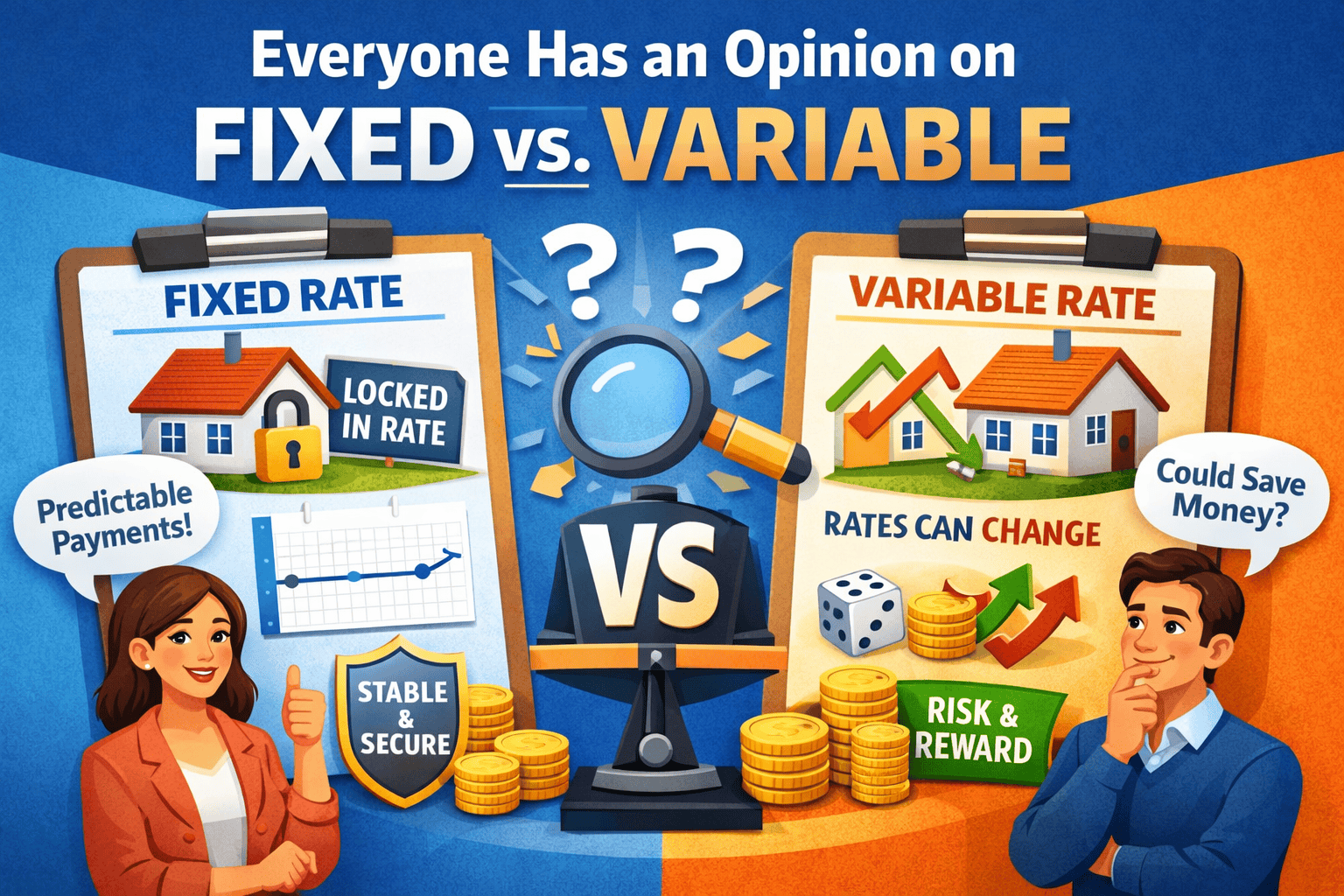
Every mortgage client asks the same question. Fixed or variable?
It's the question that generates the most debate, the most conflicting advice from friends and family, and — if you ask two different bank representatives — two completely different answers. Both sides have compelling arguments. Both sides have been spectacularly wrong at various points in Canadian mortgage history.
Here's what I've learned after helping hundreds of Ontario buyers through this decision: there is no universally correct answer. But there is a correct answer for your specific situation. And in 2026 — with the Bank of Canada holding steady at 2.25%, variable rates pricing below fixed for the first time in years, and a wave of uncertainty around trade and inflation — the stakes of getting this decision right have rarely been higher.
This article will give you the framework to make the right call for you — not the answer that's easiest to give, but the one that actually fits your life.
1. How Fixed and Variable Rates Actually Work in Canada
Before comparing them, you need to understand the machinery behind each. Most people have a rough idea — but the details matter more than you think.
Fixed Rate Mortgages
A fixed rate is exactly what it sounds like: your interest rate is locked in for your entire mortgage term — typically 1, 2, 3, or 5 years in Canada. No matter what the Bank of Canada does during that period, your rate and payment don't change.
Fixed rates are set by lenders based on Government of Canada bond yields, particularly the 5-year bond. When bond yields rise, fixed mortgage rates typically follow. When yields fall, fixed rates usually ease — though lenders don't always pass on the full decrease immediately.
✅ Fixed Rate Advantage: Fixed rates give you absolute payment certainty. You know exactly what your mortgage costs every month for the entire term. This makes budgeting predictable and eliminates the anxiety of watching BoC announcements. |
Variable Rate Mortgages
Variable rates fluctuate with the Bank of Canada's overnight policy rate. They are set as a discount or premium to the lender's prime rate (currently 4.45% as of March 2026), which moves directly when the BoC changes its policy rate.
There are two types of variable mortgages in Canada, and the distinction is important:
•
• Adjustable-Rate Mortgage (ARM): Your payment changes when the prime rate changes. Lower rate = lower payment. Higher rate = higher payment.
• Variable-Rate Mortgage (VRM): Your payment stays the same, but the proportion going to interest vs. principal changes. This type is common with RBC and other major banks.
⚡ Variable Rate Advantage: Variable rates have historically saved borrowers more money than fixed rates over the long run — but that advantage disappears during aggressive rate-hiking cycles like 2022–2023, when some variable-rate holders saw their rates nearly triple in 18 months. |
2. Where Rates Stand Today — March 2026
Understanding the current rate environment is essential context for this decision. Here's where things actually stand:
Current Metric | Rate / Status |
Bank of Canada Policy Rate | 2.25% (held since September 2025) |
Prime Rate (most lenders) | 4.45% |
Best 5-year variable rate (broker) | ~3.40% – 3.50% |
Best 5-year fixed rate (broker) | ~3.60% – 3.75% |
Best 5-year fixed rate (bank) | 4.00% – 4.50% |
Rate spread (fixed vs. variable) | Approx. 20–35 basis points |
BoC next decision | March 18, 2026 (hold widely expected) |
The headline here: variable rates are currently priced slightly below fixed rates for the first time in three years. That's a meaningful shift. For most of 2022–2024, fixed rates were meaningfully cheaper than variable — today the gap has narrowed to 20–35 basis points.
This doesn't automatically make variable the right choice. But it does change the calculation significantly compared to where things stood a year ago.
3. The Real-Money Comparison: Fixed vs. Variable in 2026
Numbers cut through the noise. Let's look at what choosing each option actually means for your monthly payments and total interest — based on today's rates.
📊 Scenario: $550,000 mortgage · 25-year amortization · 5-year term · as of March 2026
|
Factor | Variable (3.45%) | Fixed (3.69%) |
Rate | 3.45% variable | 3.69% fixed |
Monthly payment | ~$2,735 | ~$2,815 |
Monthly difference | — | ~$80 more/month |
5-year interest cost (estimate) | ~$87,900 | ~$95,200 |
5-year savings (variable) | ~$7,300 | — |
Risk | Rate may rise in 2027+ | None — locked in |
The variable option saves approximately $80/month and about $7,300 in interest over a 5-year term — assuming rates stay flat. That's the upside. The downside: if the BoC raises rates by 100 basis points during your term, those savings evaporate and you could end up paying more.
💡 Pro Tip: These numbers are for illustration. Your actual rate will depend on your down payment, credit score, amortization, property type, and whether you're applying through a broker vs. directly to a bank. A mortgage agent can run your exact numbers. |
4. Fixed vs. Variable: The Full Side-by-Side
Here is the complete comparison across every factor that matters for an Ontario buyer in 2026:
Factor | Fixed Rate | Variable Rate |
Current rate (broker best) | ~3.69% | ~3.45% |
Payment certainty | Yes — locked for full term | No — adjusts with BoC |
Payment if BoC +1% | Unchanged | Rises ~$135/month on $550K |
Payment if BoC -1% | Unchanged | Falls ~$135/month on $550K |
5-yr interest cost (today's rates) | ~$95,200 | ~$87,900 |
Break penalty | IRD — can be very large | 3 months interest — usually small |
Best for short-term ownership | No (IRD penalty risk) | Yes (lower penalty) |
Best for long-term stability | Yes | Depends on rate path |
Stress test qualifier | Both tested at rate + 2% | Both tested at rate + 2% |
Historical long-run winner | Variable (most studies) | Safer during hike cycles |
5. The 2026 Rate Outlook — What the Experts Are Saying
You can't make this decision in a vacuum. Here's what the leading Canadian mortgage and economic analysts are forecasting for the rest of 2026 and beyond:
The Consensus View: Rates Hold at 2.25%
The Bank of Canada has signalled that its current policy rate is 'about right' to support the economy while keeping inflation near its 2% target. RBC, TD, and CIBC all forecast the overnight rate holding at 2.25% through most of 2026. If this plays out, variable-rate holders are in a stable position — their rate doesn't move.
The Upside Risk: Rates Could Rise
National Bank of Canada and Scotiabank have projected a possible 50 basis point rate hike by year-end 2026, potentially bringing the overnight rate to 2.75%. This scenario is driven by tariff-related inflation pressures and stronger-than-expected economic data. If this materialises, variable-rate holders would see their rate increase by roughly 0.50%.
The Downside Scenario: A Rate Cut
If the trade war with the United States significantly damages the Canadian economy or causes a recession, the BoC could be forced to cut. This would benefit variable-rate holders — but it would require materially worse economic conditions than currently forecast.
⚠️ Important: No one — not the Bank of Canada, not the big six banks, not the mortgage industry — can predict with certainty where rates will go. Anyone telling you they know is oversimplifying. The honest answer is: rates will likely hold, could rise modestly, and could fall if things get significantly worse. |
6. The 'Sleep at Night' Test — Your Risk Tolerance Matters
Beyond the numbers, there's a question only you can answer: how would you feel if your mortgage payment went up?
Variable-rate mortgages, even in a stable environment, come with psychological costs for many borrowers. You're watching Bank of Canada announcements eight times a year. You're reading economic news through the lens of 'will my payment go up?' For some people, that's fine — even interesting. For others, it's a source of chronic stress that affects sleep, relationships, and quality of life.
That stress has a real cost that doesn't appear in a rate comparison table. If the certainty of a fixed rate is worth $80–$100/month to you for peace of mind — that's a completely rational decision. Finance is personal.
🧠 The Honest Framework Ask yourself three questions: 1. Could I comfortably absorb a $200–$300/month payment increase if rates rose 1.5%? 2. Am I planning to stay in this home for the full 5-year term? 3. Would rate volatility cause me meaningful stress in my daily life? If you answered No / No / Yes — fixed is almost certainly the right choice for you, regardless of what the numbers say. |
7. Who Should Choose Fixed — and Who Should Choose Variable
Choose Fixed If...
• You are on a tight budget with little room for payment increases
• You have dependents or other significant financial obligations
• You are risk-averse and value predictability over potential savings
• You plan to stay in the home for the full term without breaking the mortgage
• You are a first-time buyer still adjusting to the realities of homeownership costs
• The current fixed-variable spread is narrow (as it is in early 2026)
Choose Variable If...
• You have comfortable financial cushion and could absorb a rate increase
• You believe rates will hold or potentially fall during your term
• You anticipate needing to break your mortgage early (sell, refinance)
• You have a shorter ownership horizon and want the lower penalty flexibility
• You follow economic news and are comfortable with rate uncertainty
• You have historically been a disciplined saver and investor
8. The Hybrid Option: Best of Both Worlds?
Not everyone knows this, but several Canadian lenders offer hybrid or combination mortgages — where a portion of your mortgage is fixed and the remainder is variable. A 50/50 split, for example, gives you payment certainty on half your mortgage while allowing the variable portion to benefit from any future rate decreases.
This approach is particularly useful for borrowers who genuinely feel torn — and don't want to make an all-or-nothing bet. The tradeoff: managing two mortgage components is more complex, and some lenders' hybrid products come with less favorable rates than their pure fixed or variable offerings.
💡 Pro Tip: Hybrid mortgages are not widely advertised by major banks. A mortgage agent can help you identify which lenders offer them and whether the structure makes sense for your specific situation and loan amount. |
The Bottom Line
In March 2026, the honest answer to 'fixed or variable?' is: it depends — and both options are genuinely defensible.
Variable rates are currently priced slightly lower than fixed, which a rare and meaningful advantage is. But the economic environment carries enough uncertainty that choosing fixed for the peace of mind and payment stability is equally rational.
What I can tell you from experience is this: the 'best' mortgage rate is the one you can afford to keep paying if conditions change — and the one that lets you sleep at night. Saving $80/month while spending it in anxiety and antacids is not a win.
The right decision starts with knowing your numbers, your risk tolerance, and your timeline. That's exactly what a free mortgage consultation helps you figure out — before you commit.
Not Sure Which Rate Is Right for You in 2026? Let's talk through your specific situation — income, timeline, risk tolerance, and plans. A free 15-minute conversation will give you a clear, personalized answer. No obligation, no pressure. |
About the Author
This article was written by a licensed Ontario mortgage agent regulated by FSRA. Rate data is sourced from NerdWallet Canada, Ratehub.ca, Nesto, and WOWA as of March 2026. Rates change frequently — always confirm current figures before making a mortgage decision.
Previous: Article 2 — Your Bank Just Told You What You Can Borrow. Here's Why That Number Could Ruin You. | Next: Article 4 — Your Mortgage is Renewing in 2026 — Here's What You Need to Know Before You Sign Anything